Studying in Germany for UG and PG Applicants: Increased Accessibility and How to Apply (2026 Guide)

Germany is now one of the most accessible study destinations for UG and PG applicants worldwide, driven by three factors: over 1,000 fully English-taught degree programs, zero-tuition public universities, and an 18-month post-study work visa. What was once a German-language stronghold has, as of 2026, become a genuinely English-friendly system — and Stratagem Scholars exists to help you navigate the specific bureaucratic steps that stand between you and an offer letter.
Why is Germany becoming more accessible for international UG and PG students?
Three structural shifts explain the surge in international enrollment.
- The language barrier has largely dissolved for postgraduates, and is shrinking for undergraduates. German public universities now run hundreds of 100%-English-taught Master’s programs, especially in engineering, data science, and business. Bachelor’s programs remain more German-heavy overall, but English-taught UG tracks are expanding steadily each intake cycle, particularly at technical universities and private institutions.
- Public education remains tuition-free at the point of enrollment. Most German states charge no tuition fees for Bachelor’s and Master’s degrees at public universities, for domestic and international students alike. Students only pay a semester contribution (Semesterbeitrag), typically €150–€350, which usually covers administrative costs and a public transport pass. A small number of states (such as Baden-Württemberg) do charge non-EU students a modest tuition fee for select programs, so this should always be verified at the specific university level.
- The post-study runway has gotten longer and more flexible. Graduates of a German university can apply for an 18-month post-study work residence permit under Section 20 of the Residence Act (AufenthG). This permit carries no restriction on working hours — unlike the 140-day cap during studies — and the clock starts from the date of your final exam results, not your graduation ceremony. Within that window, most graduates transition to an EU Blue Card or a standard skilled-worker permit once they secure qualifying employment, positioning Germany, Europe’s largest economy, as a genuine long-term career base rather than just a study stop.
2026 Freshness Note: Germany reconfirmed the 18-month post-study permit for 2026 graduates, and the EU Blue Card salary threshold for 2026 sits at €50,700/year generally, or €45,934.20/year for shortage occupations and graduates within three years of completing their degree.
What are the differences between Germany's UG and PG application pathways?
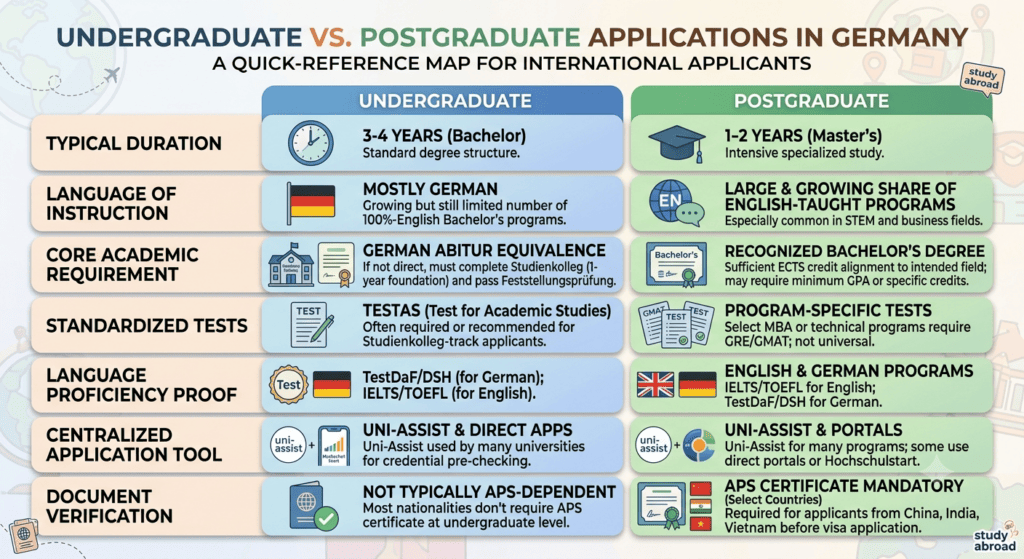
Critical Tip: Uni-Assist and APS serve different purposes. Uni-Assist checks whether your prior qualification is formally recognized as equivalent for admission. The APS Certificate is a separate, mandatory authentication of your academic documents required by German missions in specific countries before they will process your student visa — missing this step is one of the most common causes of visa delay.
How do you successfully apply to a German university?
Follow this sequence. Skipping or reordering these steps is the single biggest reason applications stall.
- Shortlist programs via the DAAD database. The DAAD’s International Programs database is the most reliable source for verified English-taught Bachelor’s and Master’s courses, filtered by field, city, and intake.
- Check whether Uni-Assist applies. Not every German university uses Uni-Assist — some run their own admissions office. Confirm this on the individual university’s admissions page before preparing documents.
- Obtain your APS Certificate early, if required. Applicants from APS-mandated countries must get their academic documents authenticated by the Academic Evaluation Centre before a student visa can even be filed. This process alone can take several weeks, so it should be started as soon as you have your admission documents ready — not after you receive an offer.
- Submit your Uni-Assist or direct university application with certified transcripts, language certificates, a tailored Statement of Purpose (SOP), and letters of recommendation (mainly for PG applicants).
- Track university-specific enrollment deadlines. Winter intake (October) applications typically close between mid-May and mid-July; summer intake (April) applications typically close between early December and mid-January. Deadlines vary by university and by whether the course is zulassungsfrei (open admission) or zulassungsbeschränkt (restricted admission).
- Open a Blocked Account (Sperrkonto). For the 2026 visa cycle, applicants must deposit €11,904 (equivalent to €992/month) into an approved blocked account before their visa appointment. This is the standard method for proving financial means, alongside accepted alternatives such as a scholarship letter or a formal sponsor declaration (Verpflichtungserklärung).
- Book your visa appointment and file supporting documents, including your admission letter, blocked account confirmation, health insurance proof, and (where applicable) your APS Certificate.
- Confirm enrollment (Immatrikulation) upon arrival, then register your residence (Anmeldung) and open a standard local bank account to receive monthly blocked-account disbursements.
Warning: International bank transfers to a blocked account can lose value in transit due to fees. Transferring a small buffer above €11,904 avoids delays in receiving your blocking confirmation (Sperrbestätigung) — a document your visa appointment cannot proceed without.
How can Stratagem Scholars help you secure admission in Germany?
Germany’s system rewards precision — the right program match, the right document sequence, and the right timeline. This is exactly where Stratagem Scholars operates as your strategic admissions partner.
Our team handles the parts of the process that most frequently derail independent applicants:
- Profile evaluation and course mapping — matching your academic background and career goals against Germany’s specific ECTS and Abitur-equivalence requirements before you invest time in an application.
- Bureaucratic navigation — managing the APS Certificate timeline and Uni-Assist submissions in parallel, so neither becomes a bottleneck.
- Statement of Purpose (SOP) tailoring — writing SOPs calibrated to what German admissions committees and, for scholarship applicants, DAAD reviewers specifically look for.
- Visa and interview preparation — including blocked account setup guidance and mock interviews for programs or scholarships that require them.
For the granular, university-by-university detail on deadlines, tuition exceptions, and regional cost-of-living differences, our Germany Country Page is the deeper resource to bookmark next.