
TMUA Exam: Complete Guide for Indian Students — Eligibility, Registration, Exam Pattern, Fees, Preparation & Universities

Are you a class 11 or 12 student aspiring to study Mathematics, Economics, Computer Science, or Data Science at a good UK university? You may be aware of three mysterious letters: TMUA. Perhaps you read about it on the course description page, or a buddy applying to Cambridge told you about it. – So, should you take it too?
Whether or not you require it depends on your university and programme. TMUA is not a standard part of the UK admissions process. This article will help you understand what it is, whether you require it, how to enroll and take it in India, and how to prepare for it according to the latest information from UAT-UK and the universities using TMUA.
What Is the TMUA?
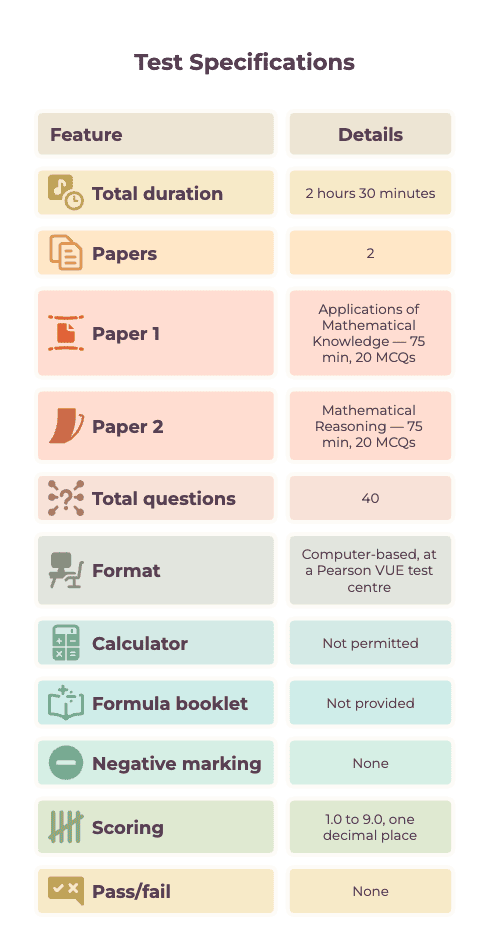
The Test of Mathematics for University Admission (TMUA) is a two hours thirty minute computer based multiple choice test assessing students’ ability to apply their mathematical knowledge and to reason mathematically rather than the knowledge of syllabus content.
It is conducted by UAT-UK (University Admissions Tests UK) which is an initiative of University of Cambridge and Imperial College London. In addition to TMUA, UAT-UK also conducts ESAT (Engineering and Science Admissions Test) and TARA (Test of Academic Reasoning for University Admission). The tests are conducted using the Pearson VUE international testing centre network.
The TMUA consists of two papers namely Application of Mathematical Knowledge (Applying known maths in unknown situation) and Mathematical Reasoning (Constructing and evaluating arguments which includes basic proofs).
These tests differ from a conventional board examination. In CBSE, ISC, or IB maths papers, students are generally assessed for accurate application of known methodologies to solve direct problems. However, TMUA question often requires identifying the appropriate concept and solving in a step-by-step manner within limited time without using calculator.
Universities use it because grades alone don’t differentiate well between thousands of high-scoring applicants for competitive quantitative courses. A test measuring mathematical thinking gives admissions teams a comparable data point across applicants from very different school systems — useful for Indian applicants, since your performance is measured on the same scale as any other candidate worldwide.
Who Should Take the TMUA?
However, not all applicants to quantitative subjects need it, and not all courses offered at TMUA-offering universities require it.
Consider taking the TMUA if: you’re applying to Maths, Computer Science, or Economics at Cambridge, Oxford, Imperial College London, LSE, University College London, Warwick, or Durham, and your particular course states it as either required or highly recommended.
You probably don’t need it if: your destination university is not on this list, your subject is not quantitative, or your specific course mentions some other test as being used (some Computer Science courses have TARA instead).
It’s important to always check the requirements if: you’re applying to several universities or courses, as there are different requirements for different courses even within one university, and some courses like joint honours (“Economics, Finance and Data Science”) have their own set of requirements.The single most important thing you should do first: check your course entry requirements page for any “additional tests” section.
Which Universities and Courses Use the TMUA?
Seven UK universities use the TMUA for 2027 entry. Requirements vary by course — treat this as a starting point and verify against the specific course page.
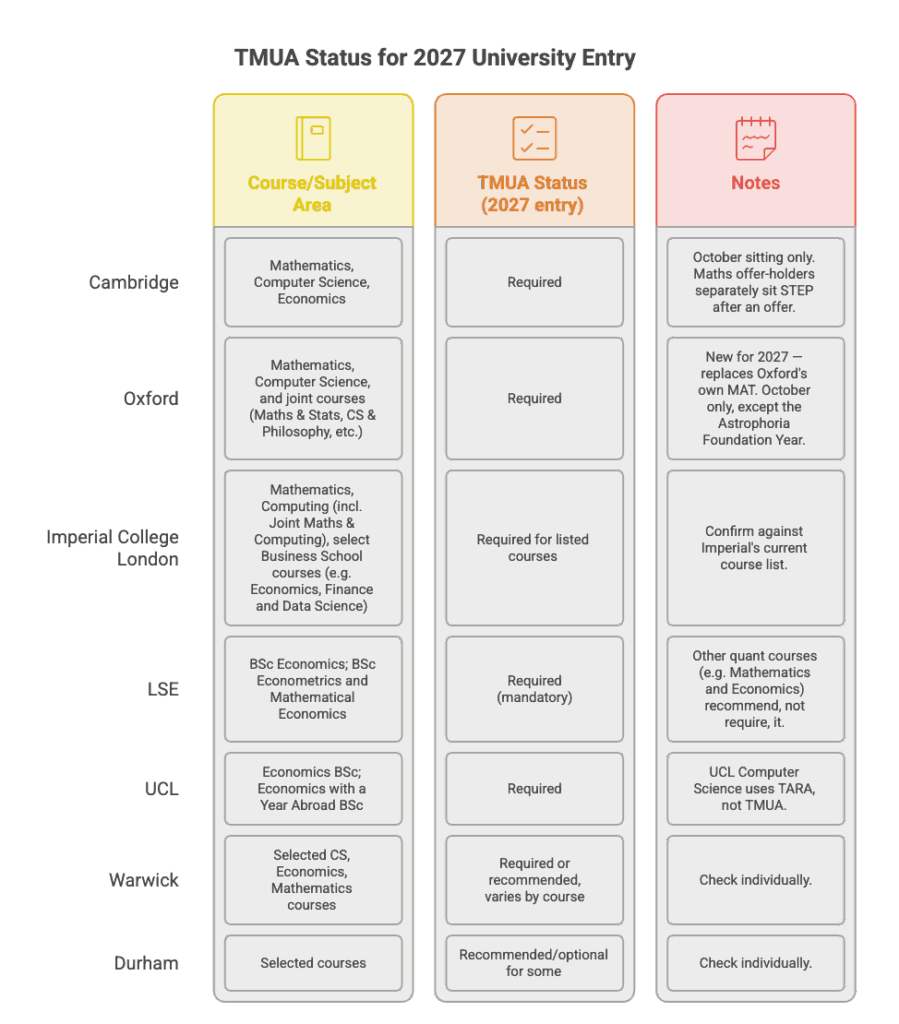
Key caveats: appearing in this table doesn’t mean the whole university requires it — usually just one or two departments do. The list of participating universities changes: Oxford joining for 2027, after using the MAT for nearly two decades, shows how quickly this shifts. And “recommended” isn’t “irrelevant” — a strong score can still help where it’s optional.
How to Register for TMUA From India
Confirm your course actually requires or recommends the TMUA — check the university’s own course page, not a general overview.
Check your application cycle and UCAS deadline, and make sure your TMUA sitting aligns with it.
Create a UAT-UK account using your full legal name (matching your ID) and the email you’ll use for UCAS.
Add a test card for the TMUA from your dashboard.
Book your test centre and slot once booking opens, choosing from available Pearson VUE centres in India.
Pay the £133 fee online by card.
Confirm your booking — Pearson VUE emails your date, time, and centre address.
Prepare for test day using the official specification and practice materials.
Access arrangements (for documented disabilities/learning difficulties) must be requested before booking — they can’t be added to an existing booking.
TMUA Exam Dates and Deadlines
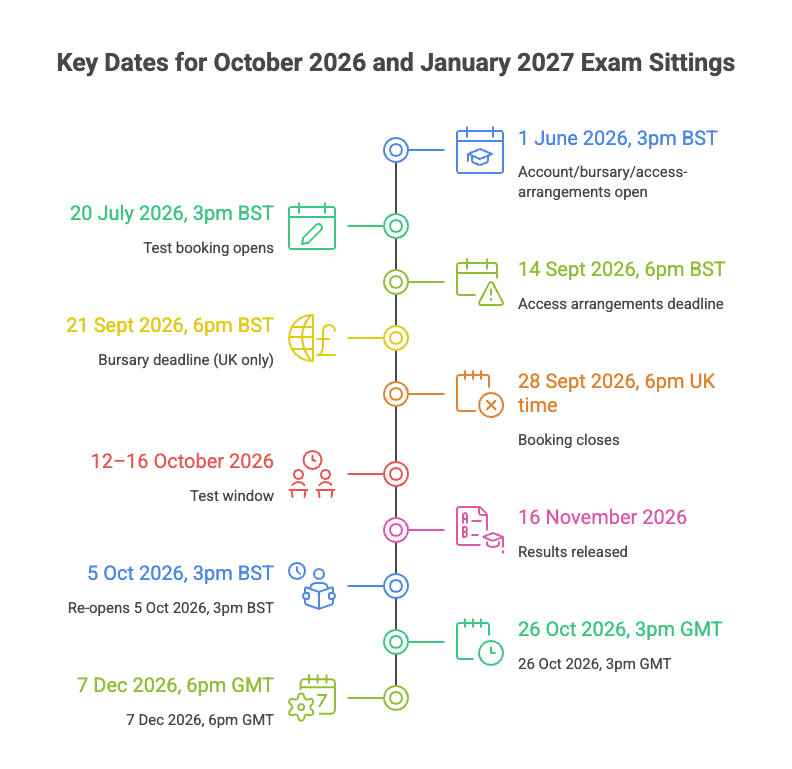
Cambridge and Oxford applicants must sit in October (exceptions: Cambridge mature colleges and Oxford’s Astrophoria Foundation Year, both with January UCAS deadlines). Applicants to the other five universities can pick either sitting — there’s no scoring advantage either way — but you may sit only once per cycle.
Simple timeline for a Class 12 student: create your account in June 2026 → book the moment booking opens in July → prepare through August–September with official materials and timed mocks → sit the test in October (or January, if accepted) → submit UCAS by your course’s deadline → receive your score in mid-November (or February), sent automatically to your listed universities.
TMUA Exam Pattern
Because there’s no negative marking, UAT-UK’s own guidance is simple: attempt every question, since a guess costs nothing.
TMUA Syllabus
The content itself won’t be unfamiliar to most Indian Class 11–12 maths students — it’s the style of testing that is. The official specification splits into two sections.
Section 1 (both papers) — broadly AS-level and Higher GCSE standard: Algebra and functions; sequences and series; coordinate geometry (lines, circles, circle theorems); trigonometry; exponentials and logarithms; differentiation and integration; graphs and transformations; number and ratio; statistics; and probability (including conditional probability).
Section 2 (Paper 2 only) — logic and proof: The logic of arguments (if/then, converse, contrapositive, negation); necessary and sufficient conditions; quantifiers (“for all,” “there exists”); proof techniques (direct proof, proof by cases, proof by contradiction, disproof by counterexample); and identifying errors in flawed arguments.
Most of Section 1 overlaps closely with CBSE, ISC, or IB mathematics — algebra, calculus, trigonometry, coordinate geometry, and probability are familiar ground. Section 2 tends to be genuinely new: the explicit treatment of logic and proof as an examinable skill, in multiple-choice format rather than write-out-a-proof style. This is usually where the most dedicated preparation time is needed.
How Is the TMUA Scored?
Each candidate gets a single overall score on a 1.0 (lowest) to 9.0 (highest) scale, to one decimal place — a scaled system that lets UAT-UK compare results fairly across different sittings and question sets.
There’s no pass/fail mark. UAT-UK is explicit that scores should be read alongside grades, personal statement, and reference — not as a standalone gatekeeper.
There’s no universal “good score.” Universities use TMUA scores differently, and most don’t publish fixed cut-offs. Treat any specific score threshold you see online as an estimate unless it comes directly from the university itself.
Scores go automatically to TMUA-using institutions listed in your UCAS application once released.
How Difficult Is the TMUA?
The mathematics is relatively straightforward for those who have done their homework; the challenge lies in the format and time constraints.
Time pressure is a very real threat, about 3.75 minutes per question, and many questions are designed to be easier to solve using the “long way.”
No calculators mean rapid and secure mental calculations as well as surd and fraction manipulations.
Multiple-choice format masks carelessness – the questions are usually such that any partial or careless approach results in an obvious wrong answer.
Proofs and logic (Paper 2) is the topic students are least accustomed to in exams, where calculation dominates.
Knowing a formula as opposed to using it flexibly is the point of the test, which is why some good rote-method students can find it difficult while the opposite may also be true.
To call the TMUA “the hardest test” simply does not make sense – the difficulty is subjective. What one might say about it: It requires different preparation from most Indian board exams, and ignoring that is a common error.
TMUA Preparation Strategy for Indian Students
UAT-UK itself notes that extensive new learning usually isn’t necessary — the priority is familiarising yourself with the test’s style, pacing, and logic-based questions.
Start 6–10 weeks ahead (longer if Paper 2 content is new to you).
Read the official specification first, so you know exactly what’s in and out of scope.
Work through official specimen/past papers before anything else.
Practise under strict timed conditions early, not just in the final week.
Review every mistake properly — a wrong answer usually reveals a concept or approach gap.
Treat Paper 2 as a separate mini-syllabus to learn deliberately.
Do full-length mocks (both papers back-to-back) close to your test date, to build stamina.
Sample 8-week plan:
Week | Focus |
1 | Read the specification and Notes on Logic and Proof; identify weak topics. |
2 | Revise Section 1 AS-level topics with untimed practice. |
3 | Revise Section 1 GCSE-level topics (ratio, statistics, probability, geometry). |
4 | Learn Section 2 (logic and proof) terminology and proof types. |
5 | Timed official Paper 1 specimen; review every error. |
6 | Timed official Paper 2 specimen; review every error. |
7 | Full timed mock — both papers back-to-back. |
8 | Review weak areas; light revision only in the final days. |
Best Resources for TMUA Preparation
Prioritise official materials: the TMUA Content Specification, official specimen/past papers, the Notes on Logic and Proof, and official mark schemes, all available via esat-tmua.ac.uk. Generic A-level-style practice can build fluency on individual topics, but always test yourself against official TMUA-style questions before your sitting, since question style matters as much as content.
Common Mistakes Indian Students Make
Assuming every UK university, or every course at a TMUA-using university, requires it.
Registering late, or missing earlier access-arrangements/bursary deadlines.
Preparing only from school textbooks, without practising the actual question style.
Ignoring timed practice until the final week.
Focusing only on formula recall, under-preparing for logic and proof.
Skipping the official specification in favour of outdated third-party guides.
Assuming one score guarantees or denies admission.
Not checking whether their target university even accepts a January sitting.
Frequently Asked Questions About TMUA
What is the TMUA exam? A computer-based admissions test assessing mathematical thinking and reasoning, used by certain UK universities for mathematics-intensive courses.
Can I take TMUA from India? Yes, at a Pearson VUE test centre in India, after registering online.
How do I register for TMUA in India? Create a UAT-UK account, add a TMUA test card, and book a Pearson VUE slot in India once booking opens.
How much does TMUA cost? £133 outside the UK/Ireland (including India); £78 for UK/Ireland candidates.
What is the TMUA syllabus? Higher-GCSE and AS-level maths, plus a logic-and-proof section tested only in Paper 2.
Is TMUA harder than JEE Mathematics? Not directly comparable — JEE covers a wider syllabus with negative marking; TMUA covers narrower content with no negative marking but heavy emphasis on reasoning and unfamiliar framing under time pressure.
Can I use a calculator in TMUA? No.
What is a good TMUA score? No universal number — it depends on the university and course, and most don’t publish fixed cut-offs.
Which universities require TMUA? For 2027 entry: Cambridge, Oxford, Imperial, LSE, UCL, Warwick, and Durham — for specific courses only.
Does LSE require TMUA? Mandatory only for BSc Economics and BSc Econometrics and Mathematical Economics; recommended for other quant courses.
When should I take TMUA? October 2026 or January 2027 for 2027 entry; Cambridge/Oxford applicants generally need October.
Can I take TMUA more than once? No — once per admissions cycle.
Does TMUA have negative marking? No.
Final Checklist for Indian Students
☐ Check your exact university and course requirement
☐ Confirm your application cycle and UCAS deadline
☐ Check TMUA registration and booking deadlines
☐ Create your UAT-UK account early, with your legal name and UCAS email
☐ Apply for access arrangements before booking, if needed
☐ Select a realistic Pearson VUE test centre in India
☐ Read the official TMUA content specification
☐ Practise official specimen questions, especially Paper 2
☐ Complete a full timed mock covering both papers
☐ Review every mock mistake, not just the overall score
☐ Submit your UCAS application before your course deadline
Conclusion
The TMUA isn’t a box every UK applicant needs to tick — it’s a specific test for specific courses at seven universities, and for many Indian students it may not be relevant at all. The first step is always establishing whether your exact course requires or recommends it, since that single fact determines your entire timeline.
If it does apply to you, the mathematics is largely within reach for a well-prepared Indian student — what usually needs deliberate work is the reasoning-heavy, no-calculator, multiple-choice format, and the logic-and-proof content most board exams don’t emphasise the same way.
If you’re unsure how the TMUA fits into your broader UK application strategy, it’s worth speaking with an admissions counsellor who can map your specific university and course shortlist rather than relying on general assumptions.