
US vs UK University Application: Key Differences (2026)

The two systems, US and Uk university applications ask for different exams, different essays, different timelines, and even different ways of thinking about your major. Get this wrong, and you’ll waste months preparing for the wrong exam or missing a deadline that doesn’t exist in the other system.
This guide breaks down every major difference- exams, applications, essays; interviews; and cost, so you can decide which path fits you, or whether to apply to both.
Key Takeaways
UK applications go through UCAS; US applications go through Common App or Coalition App — and they run on different calendars.
The UK asks you to commit to one specific major before you apply. The US lets you apply “undeclared” and explore.
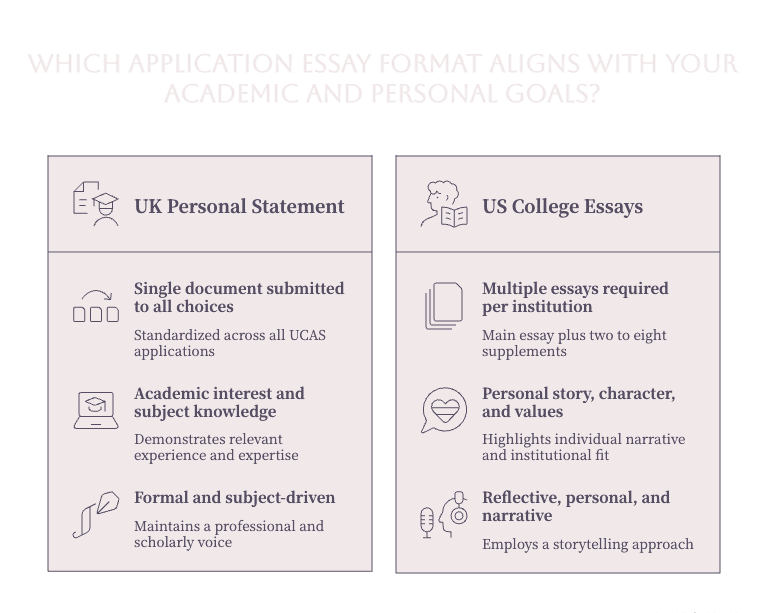
UK students submit one academic personal statement for all their course choices. US students write one Common App essay plus separate supplements for each school.
Oxbridge and UK medicine applicants face subject-specific admissions tests (BMAT, LNAT) and interviews. Most US schools don’t interview at all.
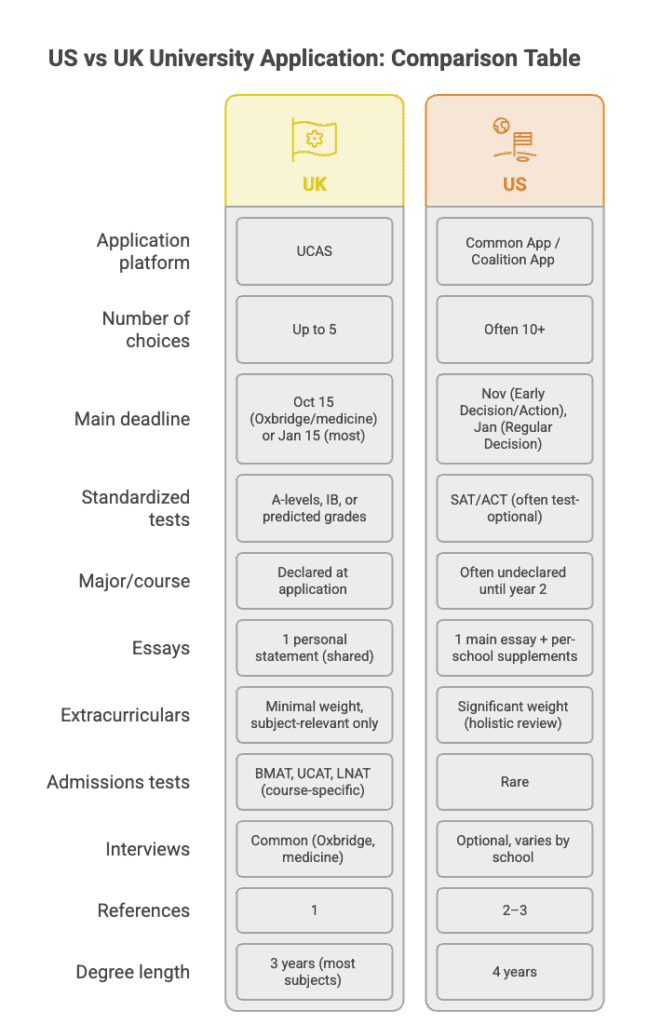
UK degrees typically run 3 years; US degrees typically run 4 years — a difference that affects total cost.
UCAS vs Common App: How the Application Systems Differ
UCAS is the UK’s centralized application portal; the Common App (and the smaller Coalition App) serves the same role in the US. Both let you apply to multiple schools with one core application, but the similarities mostly end there.
Through UCAS, you can apply to up to 5 universities in a single cycle (4 if you’re applying to medicine, dentistry, or veterinary science alongside one non-clinical choice). You submit one personal statement and one set of grades for all five. The main deadline is January 15 for most courses, but October 15 for Oxford, Cambridge, and most medicine, dentistry, and veterinary science programs.
Through the Common App, you can apply to as many schools as accept it — often 10, 15, or more — each with its own supplemental essays and requirements. There’s no single national deadline. Instead, US schools set their own:
- Early Decision (ED): Binding. You commit to attending if accepted, usually by early November.
- Early Action (EA): Non-binding. Apply early, hear back early, no obligation.
- Regular Decision (RD): The standard track, typically due in January.
SAT/ACT vs A-levels/IB: Standardized Testing Compared
The US tests general reasoning ability through the SAT or ACT; the UK tests subject mastery through A-levels, the IB, or predicted grades. This is one of the biggest structural differences between the two systems.
A-levels are subject-specific exams UK students take in their final two years of school, usually in three subjects tied directly to their intended university course. Predicted grades are a teacher’s estimate of the A-level (or IB) results a student will likely earn, submitted with the UCAS application months before final exams. UK universities make offers based on these predictions, then confirm the place once real results arrive.
In the US, the SAT and ACT are standardized tests covering reading, writing, and math, unrelated to your intended major. Since 2020, a growing number of US universities have gone test-optional, meaning you can apply without submitting scores. Many top schools, including several Ivy League institutions, reinstated testing requirements for 2025–2026 admissions, so policies vary by school and change year to year — always check the current policy before assuming a school is test-optional.
Subject Specificity: Declaring a Major vs Staying Undeclared
UK applicants must commit to one specific course of study before they apply; US applicants can apply “undeclared” and choose a major later. This single difference shapes almost everything else about each system.
When you apply through UCAS, you’re applying to a named course such as “Economics,” “Mechanical Engineering,” “Medicine” instead of the university broadly. Switching majors after enrolling is possible but often requires reapplying or restarting.
US universities generally admit you to the institution first. You can enter “undeclared” or list an intended major, then formally declare it (commonly by the end of sophomore year) after taking classes across different departments.
Personal Statement vs College Essays
The UK requires one academic personal statement shared across all your course choices; the US requires a personal essay plus separate supplemental essays for each school. The tone, purpose, and length differ sharply.
Extracurriculars and Holistic Review
US admissions weigh extracurriculars, leadership, and personal qualities alongside grades; UK admissions focus almost entirely on academic fit for the course. This is often the difference that surprises families most.
US “holistic review” means admissions officers evaluate essays, activities, recommendation letters, and grades together, looking for a well-rounded applicant with demonstrated leadership or initiative.
UK admissions are narrower by design. Extracurriculars matter only if they connect directly to your intended subject — running a coding club supports a Computer Science application; it does little for a History one. Instead, some competitive UK courses add subject-specific admissions tests:
- BMAT / UCAT — required for many UK medicine and dentistry courses
- LNAT — required for law at several UK universities, including Oxford
- Oxbridge interviews — subject-specific academic interviews for most Oxford and Cambridge applicants
Interviews: Common in the UK, Inconsistent in the US
UK interviews are standard for Oxbridge and most medicine courses; US interviews are optional or unavailable at most schools. When US interviews do happen, they’re typically informal alumni conversations rather than academic assessments.
Oxbridge interviews test subject knowledge directly — expect to work through a problem or discuss an idea on the spot with an academic in your field. UK medicine interviews often use the Multiple Mini Interview (MMI) format, a series of short, timed stations assessing ethics, communication, and reasoning.
US interviews, where offered, are usually evaluative rather than decisive, and many highly selective US schools don’t offer them at all.
Recommendation Letters
The UK typically requires one reference, usually from a school or college; the US typically requires two to three, from teachers and a school counselor. The UK reference is broader, commenting on overall academic ability and conduct. US letters are usually subject-specific, written by teachers who taught you directly, plus a counselor letter covering your school context and character.
Cost and Degree Length
UK degrees typically take 3 years to complete; US degrees typically take 4. That extra year in the US adds a full year of tuition and living costs, though it also allows more flexibility to explore subjects before declaring a major.
International student aid also differs. Need-based financial aid for international students is more common — and often more generous — at well-resourced US private universities than at most UK institutions, though UK tuition per year is frequently lower to begin with. Scholarship availability varies significantly by school in both countries, so this needs school-by-school research rather than a blanket assumption.
Which Path Suits Which Student?
The UK may suit you better if:
- You already know your intended major and want to start studying it immediately
- You’d rather commit to one focused personal statement than write a dozen different essays
- You want a shorter, more cost-efficient degree
- You test well academically but don’t want extracurriculars weighed heavily
The US may suit you better if:
- You’re not fully decided on a major and want room to explore
- Your leadership roles, projects, or activities are a real strength
- You’d rather demonstrate yourself through a personal story than a single academic case
- You want a wider range of school choices and financial aid packages to compare
Many students fit both profiles — which is exactly why applying to both systems in the same year is common and, with the right timeline, entirely manageable.
No. UK universities base offers on A-levels, IB scores, or equivalent qualifications and predicted grades, not the SAT or ACT. Some US universities, however, do accept A-level or IB results in place of SAT/ACT scores.
Both are highly selective, but the process differs more than the difficulty. Oxbridge evaluates subject mastery through interviews and admissions tests; Ivy League schools use holistic review weighing essays, activities, and academics together.
It’s possible but harder than in the US. Because UK applications are course-specific, switching majors often means reapplying to a different course or transferring, rather than a simple internal switch.
Almost always, yes. Oxbridge and most UK medicine courses require an interview, often alongside an admissions test like the BMAT or UCAT. Most other UK courses don’t require an interview.